
Our Publication
Our Goals for the Publication
Your Contributions to the Publication
Our Publication Production Materials
Our Production Schedule
Including Our Hosts
OUR GOALS FOR THE PUBLICATION
- To create a publication that embodies or activates “misfit” as a method, a citation protocol*, an aesthetic, a materiality, a placement, an epistemology, etc — and that constitutes a mutualistic set of misfit parts. [*how do we, as misfits, situate ourselves within a network of reference, an ethos of acknowledgment?]
- To practice that mutualism by creating a supportive, ethical, and enjoyable peer-review, mentorship, and mutual aid process.
- To celebrate and honor our work together, and well as the contributions of our hosts and visitors.
- To thank those hosts and visitors, as well as the other organizations and communities — the fellow misfits — that inspire, challenge, and support us.
- To serve the broader purposes of the Cross-Reference Coalition, particularly as they resonate within this particular political moment. Our obligations and interests extend beyond ourselves to the broader public knowledge / cultural heritage universe of our city — and, ideally, our work will resonate even farther.
YOUR CONTRIBUTIONS
We’ll determine the shape of our publication throughout the fall and into the early spring. You’ll each be invited to offer a short contribution in any of a variety of formats: articles, photo essays, poems, illustrations, archival dossiers, recipes, scores, etc. We’ll dedicate two entire fall sessions to publication exploration and planning (October 30 and December 4); you’ll have multiple conversations, and receive multiple rounds of feedback, from Shannon and Elaine; and we’ll host two spring workshops to collectively strengthen — and build cross-references between — one another’s contributions.
To help everyone “scale” their projects, we collectively decided that each contribution should be roughly the equivalent of eight pages. You’re all working in different formats, with various combinations of image / text / material objects / other media — so we can concretize parameters on a case-by-case basis via individual consultations 🙂
OUR PUBLICATION PRODUCTION MATERIALS
I’ve created a shared Google Folder (accessible, as always, via the email address with which you’ve registered for the class) that contains the following:
- The photos we’ve all taken on our fieldtrips (please make sure to label your files with your name so we can offer appropriate credit if we use your images in the publication!)
- A spreadsheet summarizing each participant’s contribution; feel free to edit your own entry however you see fit, and as often as you like!
- This list will help all of us find folks whose subject matter overlaps with our own; those who are engaging with similar methods or modalities or collections, etc.; those with whom we might want to consult or collaborate;
- It’ll afford our designers and production managers (i.e., Elaine and Shannon) a macro-scale picture of the publication as a whole; and
- It’ll help us round up groups who’ve offered to assist with particular aspects of the publication design, production, distribution, and celebration proceses
- A folder for each contributor where we’ll eventually gather your drafts, media assets, etc.
📌And here’s our continually-evolving Formatting + Style Guide.
OUR PRODUCTION SCHEDULE
First Workshop: Saturday, February 7, 3-6pm, at Prime Produce, 424 W 54th St (thanks, Dave!), with virtual option
Agenda: we’ll share concrete plans for our individual contributions; workshop our ideas in small groups; and, with Elaine, discuss macro-scale plans for the publication as a whole (plus how our individual pieces will (mis)fit within it 😉). We can also establish some preliminary plans for hands-on production workshops.What to bring: an outline of your contribution with enough detail to give us a concrete sense of what your piece will address, how it’ll work, and what it might look like. What do we need to know in order to give you useful feedback? If you have specific visual references, bring those. If your piece will adopt a specific graphic form — a diagram, a bureaucratic form, a particular arrangement of image and text — bring a rough sketch. Please bring a laptop or tablet to share your work in a small group setting — or, if you prefer, (5-7) hard copies to distribute.After the Workshop: Shannon and Elaine will share style and citation guidelines, which will be especially useful to those of you who expressed interest in designing your own contributions.
Second Round of (Optional) One-on-One Consultations: Friday, February 27 (1-7pm), and Saturday, February 28 (12-6pm): These are informal half-hour chats! If you’d like to discuss concrete work — e.g., collaboratively review draft text or mock-ups — you can share your screen, and we’ll look through the material together! Elaine is available to join for our Saturday sessions, but we want to minimize her burden — so if you’ll settle for Shannon alone, please aim for a Friday slot, or note on your appointment request that Elaine’s presence isn’t required 🙂 Sign up here!
Please note that Shannon is also happy to schedule individual zoom conversations or coffee chats anytime in February!
Second Workshop: Saturday, March 28, 3-6pm, at NYU’s Bobst Library (thanks, Amanda!), with virtual option. We need to make every attempt to arrive on time, please — and with photo ID’s — because Amanda has to be present in the lobby, or have a delegate present, to check all of us in!
You’ll find preparatory instructions and our full agenda here, on this secured doc.Dates to note: we’ll ask you to submit a near-final draft of your work by end-of-day on Monday, March 23; and we’ll distribute those drafts within very small groups by Wednesday, March 25.
Final Drafts Due to Shannon: April 10, end-of-day.
- You’ll find formatting and submission instructions in our Formatting+ Style Guide.
Final Rounds of Edits, Copyedits, and Proofs:Between April 10 and mid-May
- Shannon returns feedback by April 13; contributors return final edits within two weeks (by April 24 — although earlier would be very much appreciated!); Becca and Rachel work with you on any further necessary edits and copyedits; then, in early May, we pass all finalized text and images along to Elaine for design.
- For each iteration of revision, please preserve the previous draft as-is, so we can maintain a record of past edits (just in case anything gets lost or garbled!). Create a copy of that file*, name that copy to reflect its draft number [MyName_MisfitsDraft2_Date], and use that to execute your revisions 🙂
- * When creating copies in Google Docs, you’ll want to “copy comments and suggestions” so you’ll know what requires attention in your revision 🙂
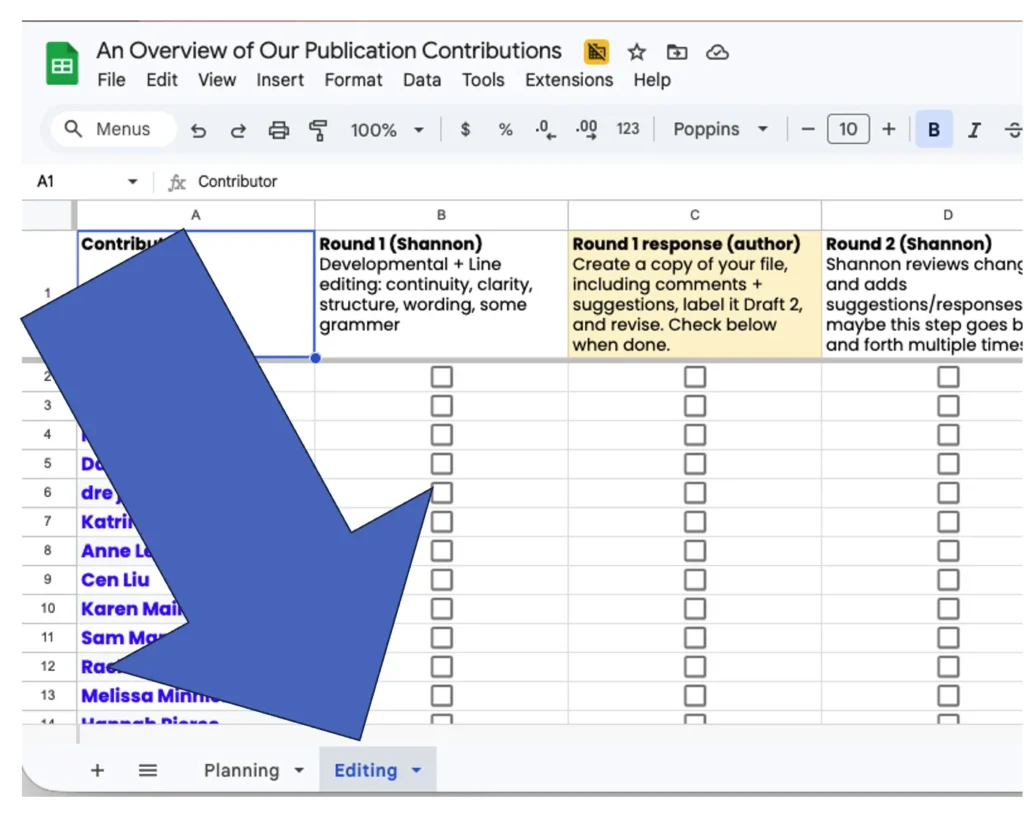
- When you’ve finished each draft — i.e., responded to all editorial queries, accepted/rejected proposed changes, resolved as many margin comments as possible (so we know where to focus our attention in the next round!) — please mark your progress on the Editing tab of our spreadsheet (see image below), so the whole production team will know that your chapter is ready for the next phase 🙂
- For each iteration of revision, please preserve the previous draft as-is, so we can maintain a record of past edits (just in case anything gets lost or garbled!). Create a copy of that file*, name that copy to reflect its draft number [MyName_MisfitsDraft2_Date], and use that to execute your revisions 🙂
Production and Compilation: You’ll find a detailed outline of our production schedule on the appropriately titled tab on our spreadsheet.
- We’re hosting a Design Workshop at Parsons, 2 W 13th St, on Tuesday, May 19, from 6 to 9pm. Elaine will lead us through some risograph and paper-cutting tutorials; we’ll invite you to engage with a print-out of the book’s proofs; we’ll print and assemble some of our special inserts; and we’ll collaboratively adorn the boxes that’ll hold the book and those misfit accompaniments.
- No food is permitted, unfortunately, and water must be kept in closed containers.
- We’ll also be inviting the Search & Discovery cohort to pitch in 🙂
INCLUDING OUR HOSTS IN THE PUBLICATION
Okay, so here’s what we can do: we’ll reconnect with our hosts, explain our purpose, and ask them to share a favorite “misfit” in their collection — and to recommend a favorite misfit collection elsewhere in the city 🙂 Here’s a potential “script,” which you’re welcome to modify:
Hello, [X]!
You might recall that our Misfits class — hosted by the Metropolitan New York Library Council and led by Shannon Mattern — visited you this past fall [link to appropriate day on class website]. Our class is now collaboratively producing an experimentally-formatted open-access publication that will chronicle our experience and feature individual contributions from each of the class participants: librarians, archivists, civic workers, media-makers, artists, and designers. We’re also eager to honor the contributions of our hosts — like you! — by including you in the publication. Yet we want to be respectful of your time, too — so I’m writing you now with a small request:
We invite you to choose a favorite “misfit” item from your own collection; share a photo of it (as high-resolution as possible!); and explain, in 300 words or fewer, what makes it “misfit” and why it intrigues, delights, troubles, or fascinates you. Then, because our class is all about fostering “cross-references,” we’d be grateful if you could recommend another local (NYC or Westchester County) library, archive, or other collection (broadly conceived!) that embodies a complementary or productively contradictory sort of misfit.
We’d also need to know how you’d like to be credited, and how you’d prefer that we reference [name of your institution]. What institutional description and contact information — address, website, etc — would you like us to include?
Thank you so much for your consideration! We’ll be sure to send a copy of the publication to your address when it’s released this summer! Please don’t hesitate to contact me and/or Shannon, at smattern[at]metro[dot]org with any questions!
I, Shannon, thought we should find a way to honor the contributions of our field trip hosts by including them in the publication, while minimizing the burden we place on them and being respectful of their time. One idea — which we can discuss in our publication-focused class sessions — is to ask each host to respond to three short questions about the role and form of “misfit” in their collections, communities, institutions, etc. We could also include a photo or two from each site — perhaps some photos we’ve taken, and/or perhaps a photo of a collection item, chosen by our host, that exemplifies misfit.