
A City of Convivial Study

In his 1973 Tools for Conviviality, theologian and philosopher Ivan Illich distinguished between two different kinds of tools, which he conceived broadly to encompass “all rationally designed devices,” from gadgets to rules to institutions. Industrially produced tools discipline their users and dictate their self-image, leading to “dependence, exploitation, and impotence.” By contrast, convivial tools enable autonomous action, giving “each person who uses them the greatest opportunity to enrich the environment with the fruits of [their] vision.” A convivial society, Illich wrote, “should be designed to allow all its members the most autonomous action by means of tools least controlled by others.”
Today, it’s clear that the United States’ dominant educational systems and the tools powering them are industrially produced. Universities have metastasized into sports media empires, real-estate development corporations, and finishing schools for American industry. Private equity managers and tech executives dominate college boards. University leaders outsource foundational decisions to ed-tech firms and management consultants whose products transform education into an instrumental, transactional, surveillant, extractive enterprise.
The fecund field of critical university studies (there’s a lot of fertilizer these days!) has historicized and power-mapped this devolution. And in recent years, as faculty, staff, and students from across the country have watched their institutional leaders capitulate to a fascistic, anti-intellectual, truth-warping regime that extends from Capitol Hill to Silicon Valley, most of academia’s denizens — recognizing that this precious and precarious educational system is unsustainable — are committed to institutional critique and, even amidst diminishing hope, building things anew.
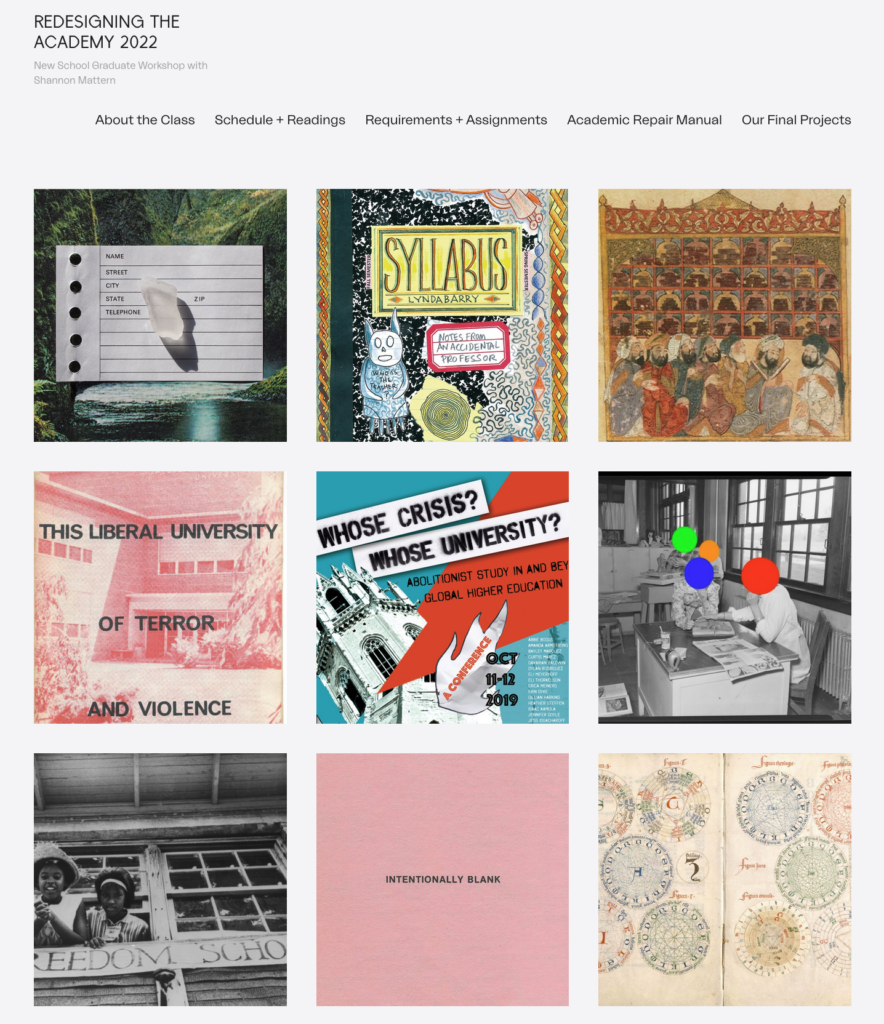
In 2022, in my final year as a full professor at The New School, I sought to engage with the painfully palpable and ever-more pervasive student and faculty disillusionment by cataloguing higher education’s threats and weaknesses — and by imagining how things could be different, better, more convivial. In creating “Redesigning the Academy” I drew on my own 20+ years’ experience as a faculty member and department administrator, my early engagement with alternative educational communities like the Public School, and my lifelong commitment to convivial learning. In that class we explored the broad terrain and deep history of alternative education, para-institutional schools, intentional learning communities, and other experimental modes of study — including many examples right here in New York City.
Those same precedents and principles, filtered through my professional experience, have inspired the Cross-Reference Coalition, which we offer as a forum for convivial study and collaboration in this age of industrialized, automated ignorance and impotence. What follows are a range of resources that cultivate the context for our work together:
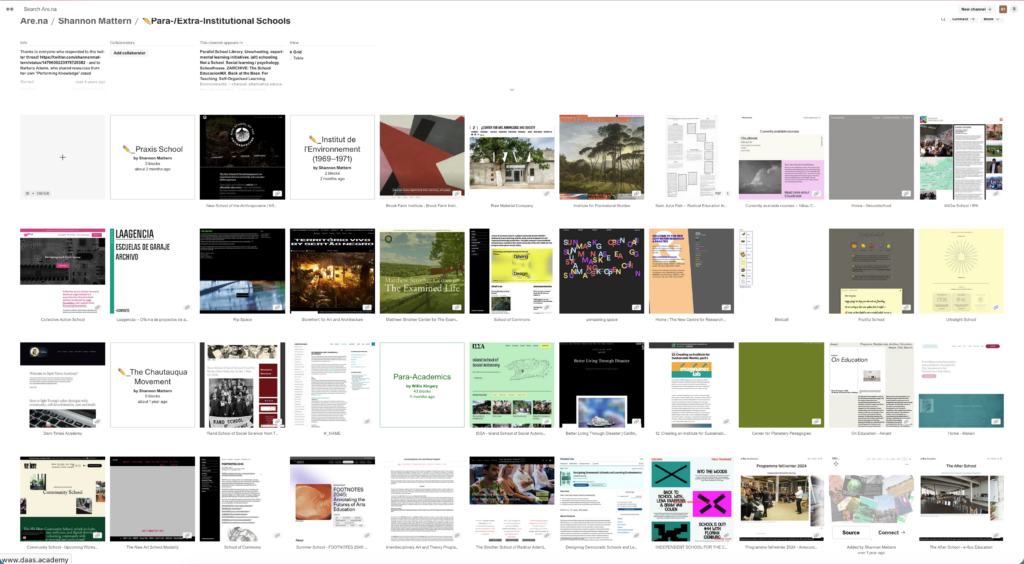
- For years I’ve been maintaining an Arena channel cataloguing hundreds of para-institutional schools, experimental colleges, and autonomous learning communities.
- Among myriad NYC-based precedents and peers include the General Society of Mechanics and Tradesmen of the City of New York (1785-), the New York Athenaeum (1824-39); the Rand School of Social Science (1906-35), The New School (1919-), the New York Workers School (1923-44), the Bard Prison Initiative (1999-), the University of Orange (2008-), Trade School (2009-19), the Brooklyn Institute for Social Research (2012-), and the School for Poetic Computation (2013-).
- We can also draw inspiration from progressive pedagogy and experimental programs within our institutions of higher learning — particularly the City University of New York. See, for instance, Conor Tomás Reed’s New York Liberation School: Study and Movement for the People’s University (Common Notions Press, 2023); Davica Savonick’s Open Admissions: The Poetics and Pedagogy of Toni Cade Bambara, June Jordan, Audre Lorde, and Adrienne Rich in the Era of Free College (Duke University Press, 2024); and the range of booklets published by Lost & Found: The CUNY Poetics Document Initiative (also freely available online on Manifold).
- In early 2026, I talked about the progressive potential and precarity of The New School — and its place within the history of experimental media education — on the occasion of media studies’ 50th anniversary at TNS.
- For a national view, we can look also to Reid Pitney Higginson’s “When Experimentation Was Mainstream,” History of Education Quarterly 59:2 (2019): 195-226; Eli Meyerhoff’s Beyond Education: Radical Studying for Another World (University of Minnesota Press, 2019); and Laura Nelson’s work.
- Among myriad NYC-based precedents and peers include the General Society of Mechanics and Tradesmen of the City of New York (1785-), the New York Athenaeum (1824-39); the Rand School of Social Science (1906-35), The New School (1919-), the New York Workers School (1923-44), the Bard Prison Initiative (1999-), the University of Orange (2008-), Trade School (2009-19), the Brooklyn Institute for Social Research (2012-), and the School for Poetic Computation (2013-).
- A few of my recent talks explore the contemporary context for convivial learning: In 2024 I keynoted the annual Digital Humanities Conference by exploring “sociotechnical assemblages for tumultuous times“; in 2024 the Barnard Center for Engaged Pedagogy invited me to speak about the role of conviviality in my own 25-year teaching career; and in 2025 the Northern New York Library Network invited me to talk about the history of — and new potential for — self-organized learning communities in or adjacent to libraries.
- Since 2004 I’ve created open-access websites for nearly all of my classes and, with their permission, shared my students’ projects. You can find an archive of that work here.