
Surfing, Browsing, Scrolling, Crawling: Web Search and Digital Discovery
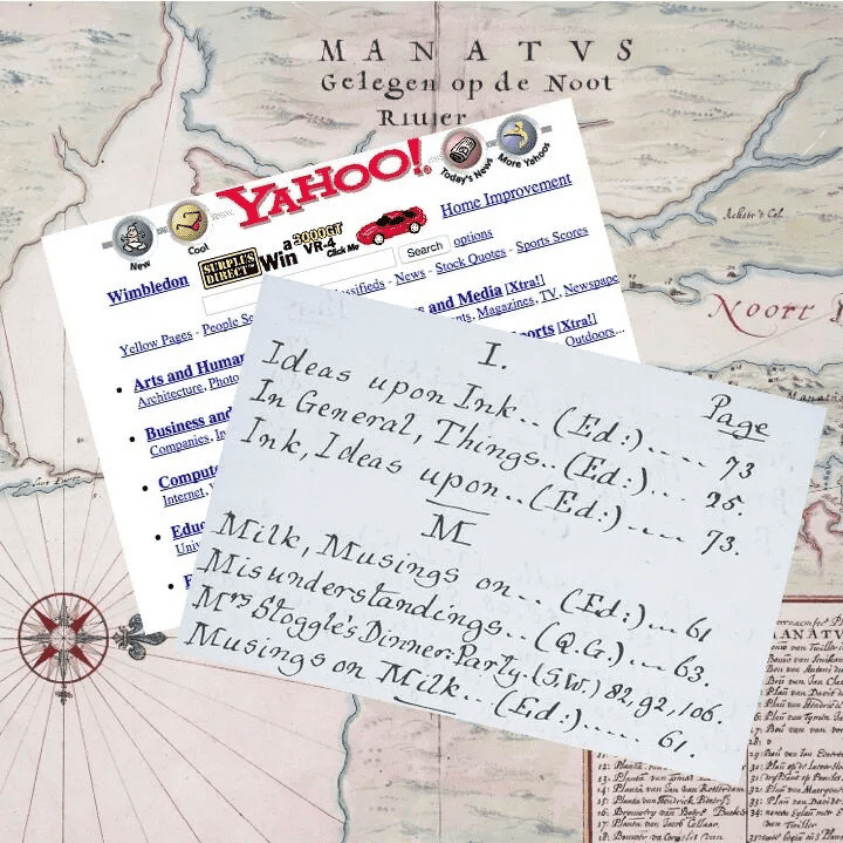

Location
This week we’ll meet at Google, [logistics here!], at 4pm with Alexis Lloyd, Senior Director, Google; Melissa Falconett, Principal Director of UX for GoogleSearch; our own Karly Wildenhaus, Manager of Metadata Services at the NYPL; and Sam Lavigne, Artist and Parsons Faculty Member. Please bring a government-issued ID to access the building.
Agenda
We’ll think about whether and how we might apply the cartographic legacies and modes of discovery we addressed in previous weeks to the digital realm. Our exploration will extend from the evolution of search engines, particularly as they’ve responded to new techniques and technologies (like SEO and AI); to the disparate (but perhaps ever-more-aligned, for better or worse) goals informing commercial web search and library discovery tools; to speculative, activist, and poetic digital discovery tools.
To Prepare for Today
(Sorry — this is an ambitious list! I couldn’t help myself! Feel free to skim 😉)
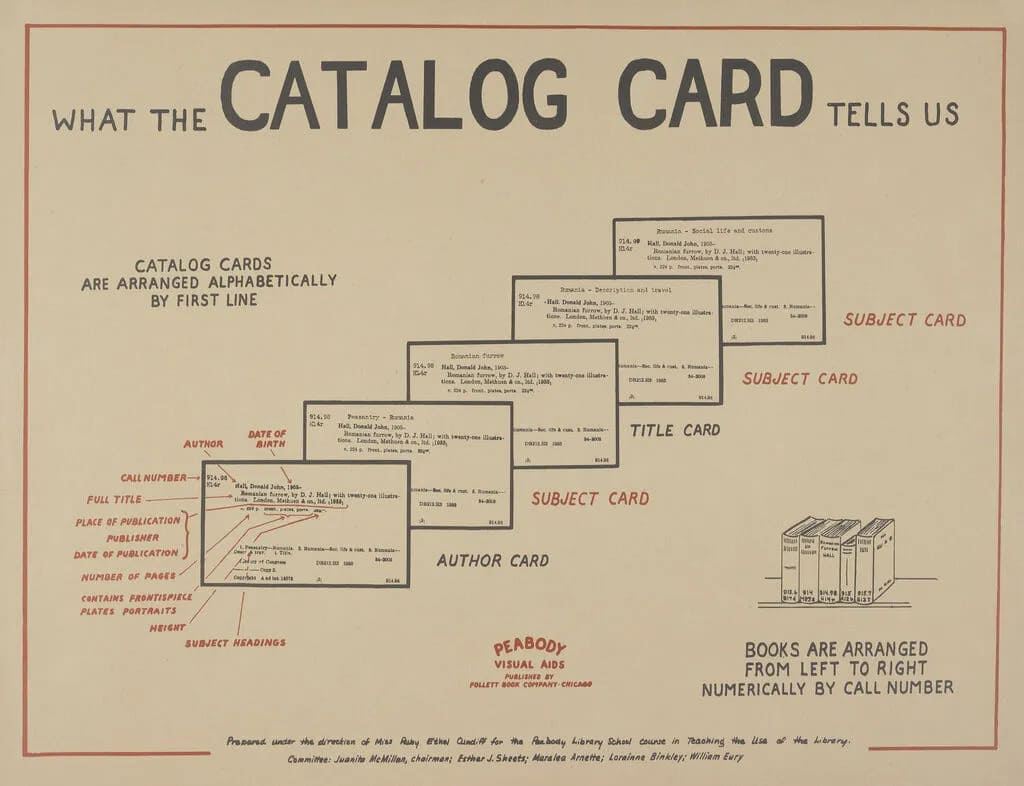
- How did we ever find stuff before the Internet?!? Recall our earlier discussion of reference resources! Think about indexes and card catalogs and other bibliographic and infrastructural scaffolds, too! 🙂 Now, read Anton Tantner, “Before Google: A Pre-History of Search Engines in Analogue Times” in René König and Miriam Rasch, eds., Society of the Query: Reflections on Web Search, INC Reader 9(Institute of Networked Cultures, 2014): 122-38; and skim the book’s table of contents to see what critical questions other scholars raised about web search in 2014. How might we update those questions for 2026?
- See, too, the INC’s list of search engines.
- Let’s now consider the commercial search tool so ubiquitous and naturalized it’s become a generic verb: Read Google’s brief “In Depth Guide to How Google Search Works,” watch Toluse Akinlabi, “The Evolution of Search: Drive Growth & Efficiency,” Google Ads (October 15, 2025) [video: 20:35], and consider whose interests have been prioritized, and what values have been centered, throughout the tool’s evolution.
- Why is it now so much harder to find what we’re looking for online? Web rot, search engine optimization, AI slop, AI summaries and the decline of “click-through traffic” are among the forces contributing to search’s devolution. Read Emanuel Maiburg, “Google’s AI Is Destroying Search, the Internet, and Your Brain,” 404 Media (July 23, 2025); pdf here [thanks, Karly!]. If you’re not already familiar, 404 Media is a worker-owned critical tech publication!
- Now, let’s explore library discovery tools and consider how their purposes might differ from — but their UX might be shaped by — commercial search engines. Read Monica Westlin, “Ingenious Librarians,” Aeon (June 5, 2023) and Ruth Kitchin Tillman, “Introducing Discovery Systems” (October 5, 2022).
- Optional: Consider alternative Latin American genealogies of information search: Read Rodrigo Ochigame, “Informatics of the Oppressed,” Logic(s) 11 (August 2020).
- How have vendor politics and AI transformed (and compromised) library discovery and labor? Read Mike Olson, “Beyond Classification: The Human Cost of Library and Information Labor Under Digital Capitalism,” Scholarly Kitchen (August 26, 2025).
- Let’s consider some (perhaps unreplicable and unscalable) library alternatives: Skim the Library of Congress’s “Experimental Access to Digital Collections and Data: Final Report: Project Overview, Findings, and Recommendations” (March 2022), and check out the LoC’s Experimental Access tools.
- Optional: See also the work of the much-beloved-but-now-defunct NYPL Labs: Matt Miller, “The Networked Catalog,” NYPL Blogs (July 31, 2014); the NYC SpaceTime Directory (which has evolved into AllMaps); and my conversation with former NYPL Labs Director Ben Vershbow: “Urban Memory Infrastructure,” Urban Omnibus (March 1, 2017).
- Finally, let’s consider some speculative, activist, and poetic alternatives.
- Read Elan Ullendorff, “Folk Search Engines,” Escape the Algorithm (February 20, 2024) and explore his website!
- Skim through Feminist Search Tools.
- Read about Are.na in “Charles Broskoski on Self-discovery That Happens Upon Revisiting Things You’ve Accumulated Over Time,” The Creative Independent (October 15, 2017).
- Explore the work of Sam Lavigne.
Supplemental Resources
- M.D. Ashikuzzaman, “The Role of Discovery Tools in Modern Libraries,” LIS Education Network (June 12, 2024).
- Marshall Breeding, “History of Mergers and Acquisitions in the Library Technology Industry.”
- Kyle Chayka, “” The New Yorker (June 12, 2024).
- Brian X. Chen, “Is A.I. the Future of Web Browsing?” The New York Times (July 11, 2025).
- Brian X. Chen, “A.I. Is Giving You a Personalized Internet, But You Have No Say In It,” The New York Times (February 10, 2026).
- Cory Doctorow, “The Specific Process by Which Google Enshittified Its Search,” Pluralistic (April 24, 2024).
- Matt Enis, “Highly Recommended” [academic discovery “solutions”], Library Journal (June 9, 2025).
- “Finders, Keepers: Search – A Symposium Review,” Sitterwerk (2021).
- ** Hana Lee Goldin, “Google Has a Secret Reference Desk. Here’s How to Use It,” Card Catalog (February 24, 2026) [thanks, Holly!!].
- John Herrman, “SEO Is Dead. Say Hello to GEO,” New York Magazine (August 4, 2025).
- ** Adrianne Jeffries and Leon Yin, “Google’s Top Search Result? Surprise! It’s Google,” The Markup (July 28, 2020) [thanks to chris xu!].
- Jason Koebler, “Google Search Really Has Gotten Worse, Researchers Find,” 404 Media (January 16, 2024).
- Adrienne LaFrance, “Searching for Lost Knowledge in the Age of Intelligent Machines,” The Atlantic (December 1, 2016).
- Deidre Lynch, “In Praise of Search Tools,” Public Books (January 6, 2022).
- Astrid Mager, Ov Cristian Norocel, and Richard Rodgers, “Advancing Search Engine Studies: The Evolution of Google Critique and Intervention,” Big Data & Society 10:2 (July 27, 2023).
- Rodrigo Ochigame and Katherine Ye’s “Search Atlas,” ACM SIGCHI (2021).
- Emma Roth, “Google Admits the Open Web Is in ‘Rapid Decline,” The Verge (September 8, 2025).
- Jeffrey Schnapp, “Knowledge Design,” A/R/P/A Journal 2 (October 13, 2014); see the whole “The Search Engine” A/R/P/A issue.
- s.e. smith, “How To Disappear Completely,” The Verge (December 18, 2024); available on archive.today
 [thanks to Jess Rauchberg for the recommendation!].
 - Ruth Szpunar, Eric Bradley, Erin Gabrielson, and Catherine Pellegrino, “Irrelevant Discovery Layers? An Evidence-Based Evaluation of Three Common Library Search Tools,” Information Technology and Libraries 44:2 (2025) [thanks, Holly!].
- Amelia Tait, “Before Smartphones, an Army of Real People Helped You Find Stuff on Google,” Wired (June 21, 2024).
- Clive Thompson, “A Quick Primer on ‘Rewilding Your Attention,’” Medium (August 13, 2023).
- Francesca Bolla Tripodi, The Propagandists’ Playbook: How Conservative Elites Manipulate Search and Threaten Democracy (Yale University Press, 2022).
- ** Elan Ullendorff, “Anti-Viral with Alicia Kennedy,” Escape the Algorithm December 2, 2025).
- Elan Ullendorff, “How Did You Find Me?”
- Elan Ullendorff, “So You Want to Escape the Algorithm,” Escape the Algorithm (January 16, 2025).
- Siva Vaidhyanathan, The Googlization of Everything (And Why We Should Worry) (University of California Press, 2012).
- Alex Valencia, “AI & Google Search: The Story So Far,” We Do Web (July 7, 2025).
- Mitchell Whitelaw’s Generous Interfaces.
- Robert Wisneski, “I Can’t Get No Satis-Searching: Reassessing Discovery Layers in Academic Libraries,” Journal of Web Librarianship 18:1 (2024).
- Edward Zitron, “The Man Who Killed Google Search,” Where’s Your Ed At? (April 23, 2024).