
Exploration’s Cartographic Genealogies

Location
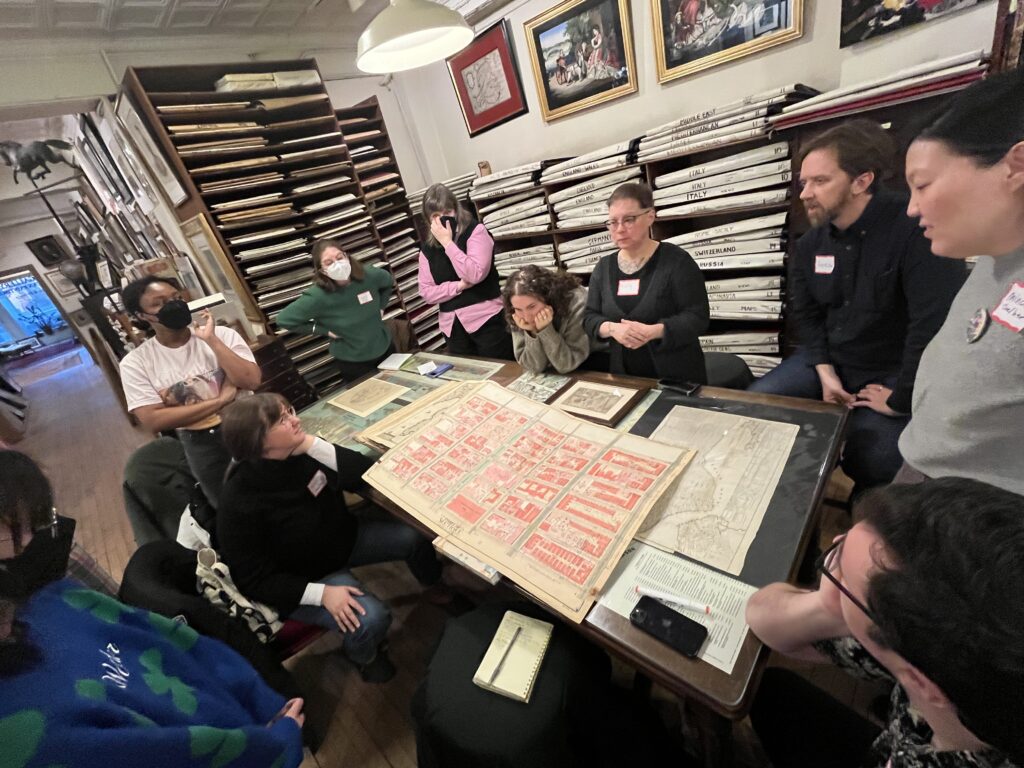
We’ll meet at 4pm with map curator at the Argosy Book Store’s map gallery, 116 East 59th Street, Manhattan, second floor
Agenda
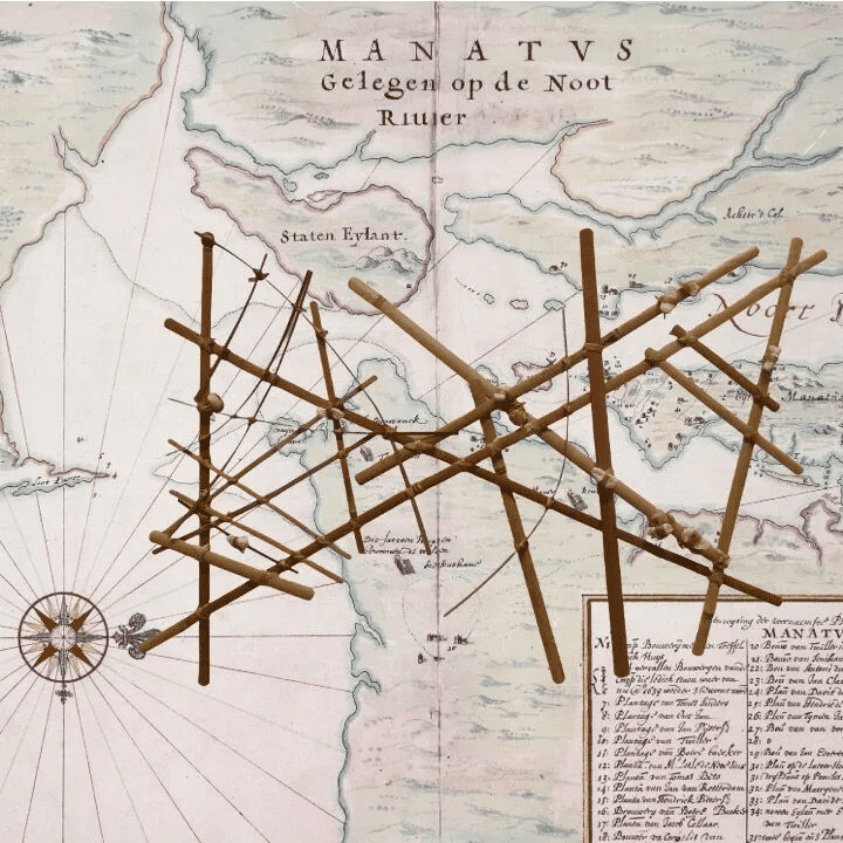
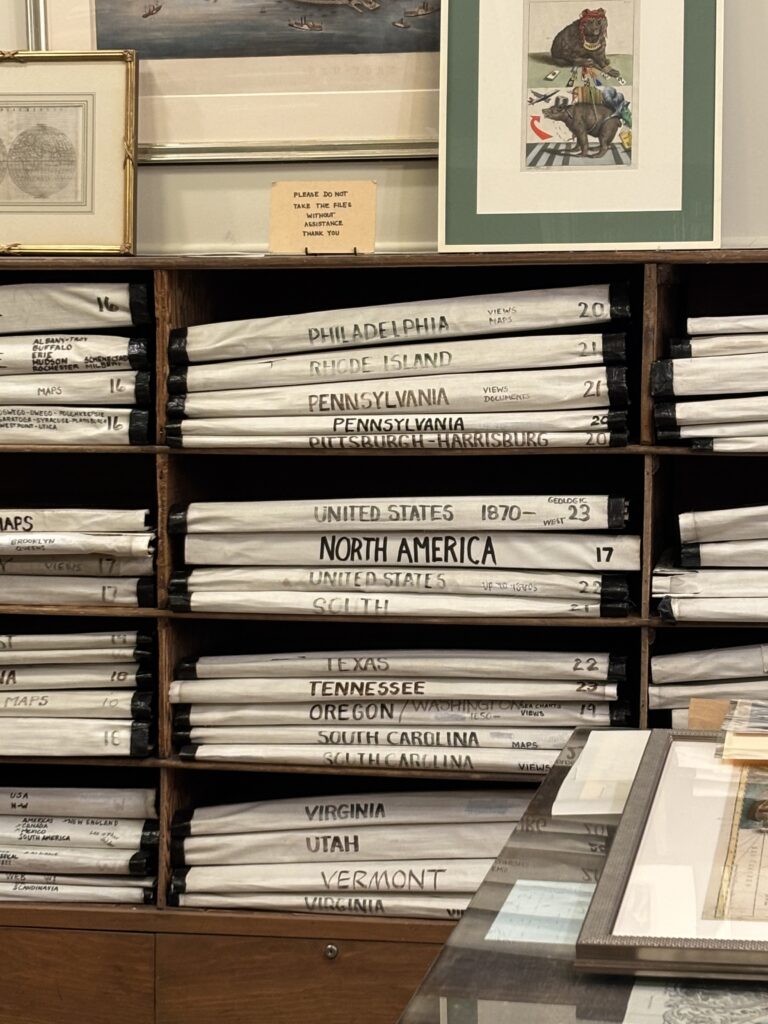
This week we’ll study the complicated pasts, presents, and futures of global — and even extra-planetary — exploration and the “discovery” of “new worlds.” We’ll consider legacies of exploration driven by territorial expansion and Manifest Destiny, scientific cataloguing and collection, infrastructural development and trade, silk and spices, resource extraction and slavery — as well as the archival artifacts and cartographic scripts of these regimes. Yet rather than ceding creative and intellectual ground to colonial forces, we’ll also explore alternative genealogies of exploration and cartography that embody different ontologies, epistemologies, and politics — that prioritize stewardship, reciprocity, and commoning. In addition, we’ll explore map dealers’ methods of exploration in building a collection, as well as their relationships to archives and libraries. Laura has also invited us to stay after, chat, and enjoy some prosecco in the gallery 🎩
To Prepare for Today
First, please read my little explanation / reassurance about our weekly reading lists 🙂
- I can’t tell you how long I searched for a pithy yet broad and accessible history of global exploration! 😮💨 Here’s the best I could find: a special issue published by the Gilder Lehrman Institute of American History, a NYC-based organization dedicated to K-12 and public history education. Please read Carol Berkinc’s editorial introduction to “The Age of Exploration,” History Now 12 (Summer 2007), as well as Ted Widmer’s “Navigating the Age of Exploration,” and skim any other chapters that interest you!
- We can map certain chapters of the history of cartography onto the history of exploration. (Della Zazzera’s interactive essay, listed in the Supplemental Resources below, is fantastic — but it exemplifies the challenges of digital archiving: all the maps are missing!) Today, we’ll explore the stellar collection of antique maps at the Argosy Book Shop. Please introduce yourself to Argosy, read Corey Kilgannon on the shop’s legacy (“One Bookstore, Three Sisters, and 100 Years,” The New York Times (November 1, 2025)), and learn about its Gallery and the gallery’s director, Laura Ten Eyck.
- Farther Afield: For more local map collections and exploratory archives, you might like to explore, on your own time, the Explorer’s Club’s Collections, the Lionel Pincus and Princess Firyal Map Division @ the NYPL (as well as the NYPL’s resources on Christopher Columbus’s four voyages), the South Street Seaport Museum’s collections, and the New York Botanical Garden’s Welika Project, which chronicles the natural history of NYC before colonization.
- How do map dealers and curators explore the cartographic universe — and how does their work orient our experiences of search and discovery? Read Michael Buehler, “Why the Map Trade Still Matters in the Age of the Internet,” Boston Rare Maps (August 30, 2019).
- Now, let’s consider some alternative exploratory biographies and genealogies. Skim the Explorer’s Club’s “Society of Forgotten Explorers” and read about artist Tavares Strachan’s work with speculative Bahamian exploration in Zoë Lescaze, “The Artist Whose Medium Is Science,” The New York Times Magazine (September 20, 2020) OR read about Thandi Loewenson’s archival investigation of African space exploration in “Celestial Settler Frontiers,” e-flux architecture (March 17, 2025).
- See also the work of Beatrice Glow.
- For what it’s worth, I’ve taught a variety of map-focused classes over the past two decades. You’re welcome to browse through my “Maps as Media” (pw = fairuseisgreat!) and “Mapping the Field” class sites, which contain lots of potentially useful resources — particularly on indigenous mapping, map art, sensory mapping, etc.
- Update Feb 20: Optional: Laura, our host, has encouraged you to take a look — if not now, then perhaps sometime in the future! — at Charles Stankievech’s work on geographic technologies in the Arctic; here’s a gallery guide, and here’s an e-flux article 🙂
Fieldwork Documentation
Supplemental Resources
- George Bey, Bethanee Bemis, and Lacey Flint, “Exploration in the 21st Century,” Explorer’s Club (December 15, 2025).
- Michael Blanding, The Map Thief: The Gripping Story of an Esteemed Rare-Map Dealer Who Made Millions Stealing Priceless Maps (Avery, 2014).
- David Buissert, “European Maps for Exploration and Discovery,” Mapping Movement (The Newberry, 2016).
- David A. Chang, The World and All the Things Upon It: Native Hawaiian Geographies of Exploration (University of Minnesota Press, 2016).
- Kenneth Chang, “Google’s Former C.E.O. Wants to Create a Cosmic Search Engine,” The New York Times (January 9, 2026).
- Roger Crowley, Spice: The 16th-Century Contest that Shaped the Modern World (Yale University Press, 2024).
- ** Elizabeth Della Zazzera, “First You Make the Maps,” Lapham’s Quarterly (2019); via the Wayback Machine.
- Caroline Dodds Pennock, On Savage Shores: How Indigenous Americans Discovered Europe (Knopf, 2023).
- Joseph H. Genz, Breaking the Shell: Voyaging from Nuclear Refugees to People of the Sea in the Marshall Islands (University of Hawaii Press, 2018).
- Tao Leigh Goffe, Dark Laboratory: On Columbus, the Caribbean, and the Origins of the Climate Crisis (Doubleday, 2025).
- History101, “1600s New York: From Dutch Outpost to English Rule.”
- John Edward Huth, The Lost Art of Finding Our Way (Harvard University Press, 2015).
- Thandi Loewenson, “A Taxonomy of Flight,” Serpentine Gallery (December 10, 2020).
- Janet Malcolm, “” (on the Argosy Book Shop), The New Yorker (June 16, 2014).
- Kathleen S. Murphy, Captivity’s Collections: Science, Natural History, and the British Transatlantic Slave Trade (UNC Press, 2023).
- New Amsterdam History Center, Mapping Early New York.
- NYPL, Historical Maps and Atlases.
- Derek Kane O’Leary, “New Netherlands, Archival Deficiency, and Contesting New York History in the Antebellum U.S.,” Dutch Crossing 43:3 (2019): 252-69.
- PBS Education, “Age of Encounter | Explorers and Navigators,” PBS World Explorers.
- Londa Schiebinger and Claudia Swan, eds., Colonial Botany: Science, Commerce, and Politics in the Early Modern World (University of Pennsylvania Press, 2007).
- John Rennie Short, Cartographic Encounters: Indigenous Peoples and the Exploration of the New World (Reaktion, 2009).
- “Tavares Strachan: Cosmic Visions and Hidden Histories,” Frieze (2022).
- Peter Whitfield, New Found Lands: Maps in the History of Exploration (Routledge, 2015).