Space for Conversation
Embodying our Ethics
Communicating online today is more than a little fraught. In the best case scenario, the platforms we trust will keep our messages safe, will keep our account information private, and will not use data they collect about us for their own gain. As we’ve seen over and over in recent years, though, there are myriad ways to fail in each of these pursuits. A data breach at Discord in October 2025, for example, resulted in attackers accessing 70,000 users’ government IDs, selfies, and other sensitive information collected as part of a new age verification mandate. Annual roundups of the worst hacks of the year have become a (very depressing) end-of-year tradition.
These issues have been at the top of our minds in considering where online communications might happen within, and between, Cross-Reference Coalition (CRC) cohorts. “Rejection of surveillant technologies and instrumentalist learning” has been a guiding principle of the program from the beginning. But what platforms do we still trust to embody that spirit?
Exploring Options
At the start of Search and Discovery, the CRC’s Spring 2026 class, the desire to explore collaboration platforms that didn’t have “big tech” associations became even more of a priority. Dr. Mattern asked participants, “ How can we “balance accessibility, functionality, and familiarity with security, privacy, and minimization of fascist enablement?”
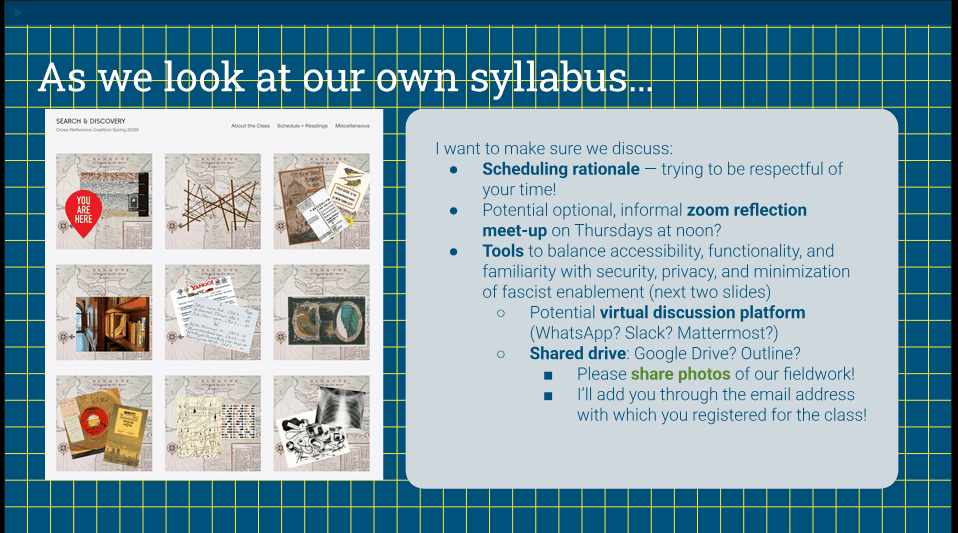
Other questions we asked included: What are our concerns with Google, Slack, WhatsApp, and the like? What are our needs for chat + docs platforms? What platforms could serve successive cohorts in future years, growing as the program grows? In addition, how important is it that we host our own instance and control our own infrastructure? Is that even possible?! Any tool we choose should:
- Be affordable
- Be accessible in multiple senses of the term: it had to support those who used screen readers, it had to have a low barrier to entry and use
- Offer end-to-end encryption
- Be generally ethical (there’s a low bar in Silicon Valley these days!)
And, after doing some of our own research, and asking class participants and colleagues for recommendations, we came up with a long list of possible platforms that included CryptPad, Discord, Element, Knowledge Commons, Mattermost, Proton, Signal, Slack, Tresorit, and Zulip. For a little while, we were both overwhelmed as we compared all the features, price points, and possibilities.
Landing on Zulip
Over the first year, we relied on WhatsApp and Signal, but knew we would eventually want something that could support multiple channels to facilitate day-to-day chatter, collaborative project planning, and long-term community-building. While avoiding Gmail and Google Docs is also a longer-term goal, finding the right online community space has been our most pressing priority.
Among the options, Zulip stood out as an open-source, extremely customizable, mobile-friendly, transparent, and well-documented option. It also offers both cloud-hosted and self-hosted versions, and the possibility of moving between the two. (Self-hosted would mean we could fully control our own data—though, we found, we would have to spin up an AWS server to go that route. A post for another day.) When we reached out, they also offered to let us have their Standard plan for free because we’re based at a small nonprofit—a perk they also offer to open-source projects, research groups, academic conferences, and community groups.
After much deliberation, we determined that Zulip feels like the most flexible and values-aligned platform for the program, at present. (Just a couple weeks ago, the team who leads development announced four senior team members were leaving for Anthropic with a new, non-profit Foundation governance structure in place. It will be interesting to see what, if anything, this changes.)
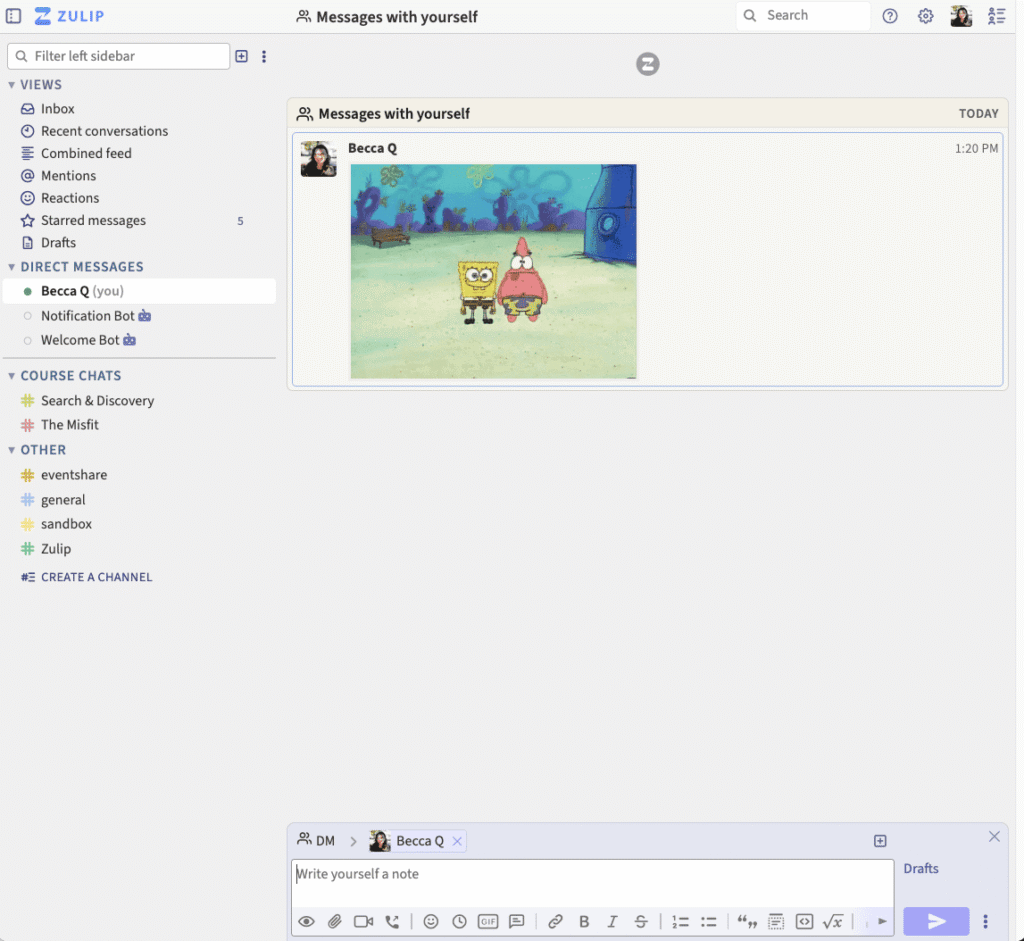
Class participants will have received an invitation to create an account. We hope you’ll bear with us as we work through the adjustment of setting options, managing frustrations, and re-establishing norms — all of which come with onboarding a group into a new space! We invite you to help us cultivate the fun, respectful, and joy-filled online community we want to see in the world. Talk to you there!
With thanks to the Search & Discovery class participants, and Karly Wildenhaus especially, for their ideas and recommendations.